Homeschool Terms
Below are definitions commonly used within the homeschooling community, but note that except for private schools, these definitions are not written into law and therefore the definitions are not set in stone.This means the interpretation of each is left to the person reading and/or operating one of the following.
Homeschool Support Group
Usually offers support such as social opportunities, information about Homeschooling, opportunities for parents to discuss what's going on with their Homeschooling and areas they need assistance in, etc. They may host some clubs or a few classes, but they are very informal.
Homeschool Co-op
Traditionally a group more focused on classes but organized by parents who share responsibilities in offering those classes. They may pool resources to hire teachers, but usually the teachers are members from the group. They may offer some of the things offered by homeschool support groups, but the focus of a co-op is on classes.
Hybrid School
A hybrid school is not a full-fledged private school as it does not meet with a full-time schedule. Many will meet two or three days a week. They are typically set up by a few people rather than a whole group.
Micro School
A micro school blends the best of homeschool and traditional school in a small, personalized setting.
-
Small class sizes
-
Muli-age learning
-
Individualized instruction
-
Family partnership
-
Faith-based environment
Students receive structured academic instruction while benefiting from flexible pacing and relational teaching.
Homeschool Pod
A pod maybe set up by a few parents or by a teacher, but typically falls in a professional teacher teaching a group of homeschoolers. Typically the number of students is less than 10.
Private School
An actual private school is registered with the Florida Department of education and all require a birth certificate and health records in order to register. It will have an official FL DOE number and is required to keep attendance and other records. Their students would not be on the PEP nor Home Education. Legally, the school directs their education and records, such as transcripts or report cards or diploma must be provided by the school rather than the parent.
Difference between Home Education and PEP
-
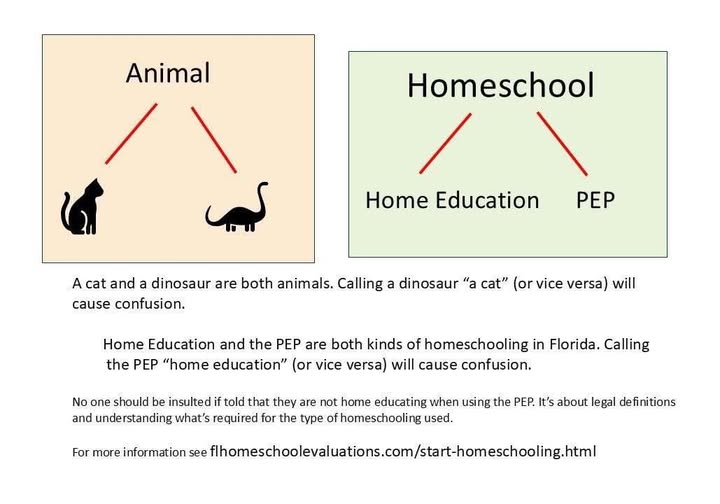
Home Education and the PEP are not the same thing.
-
Home education and the PEP cannot be done together.
-
Home Education has a specific meaning in Florida law. The PEP is a different option for Homeschooling In Florida law.
-
Using Home Education as though it is a synonym with Homeschooling will confuse many people. It may seem pedantic to insist that terms are used correctly, but it helps prevent a lot of legal confusion when the words are used in accordance with Florida law.
-
Home Education and the PEP both allow parents to educate their own children. Both allow parents to choose any methods or materials they like. Both allow parents to choose the levels of materials used with their children--though the PEP requires them to name grade level, and Home Education does not.
-
The PEP requires reporting to a scholarship funding organization--for most people that is Step Up For Students though it could be AAA Scholarships instead. While Home Education requires reporting to the school district instead--the law strictly limits the school district role so they are not putting demands on the parent, but they receive the paperwork and record it.
-
The names of documentation are different between the two options. The PEP requires a student learning plan on file; this is part of the PEP application and is a simple multiple choice form to fill out.
-
On the other hand, Home Education requires filing a letter of intent that informs the school district that your child's education is under your control now.
-
These two forms serve the same legal purpose as they keep the child from being considered truant.
-
The PEP provides funding from the state. Home Education can be used by those using the unique abilities scholarship for special-needs students, but it is also used by a lot of people who do not take funding from the state.
-
The PEP absolutely requires testing, using one of the approved tests on the Florida Department of Education's website; test results must be submitted to the scholarship funding organization this year by May 31.
-
Home Education allows for testing options for its annual evaluation requirement but has other options too.
-
The portfolio review evaluation option is not a test and simply requires showing some of the records kept to show that the student is learning.
-
The Home Education evaluation has a different deadline than the PEP. The Home Education evaluation is due by
1. The anniversary of the letter of intent if you are planning to continue Home Education.
2. Within 30 days of stopping Home Education if you are not continuing with Home Education. (if you are switching to the PEP for next school year, and are currently home educating, you would submit an evaluation at the end of this school year with a letter of termination).
-
The PEP currently must be applied for between February 1 and the end of April in order to get it for the following school year. Whereas Home Education can be started at any point in the year.
-
Why are the PEP and Home Education options different? Why do they report paperwork to different offices? Why does their beginning paperwork go by different names?
Home Education was put into law back in the mid 1980s by Homeschooling parents who wanted to stop districts who were putting people in jail or taking custody of kids because they thought they were truant. The laws were set up to make Homeschooling easy and clearly Legal and to strictly limit school district's power. The portfolio and evaluation requirements were put in the law to be easy for Homeschool parents, but to assure districts that there were no loopholes, allowing truancy--that Home Education would not be an excuse for simply not educating. These laws have been in place for decades.
The PEP was introduced in 2023. The laws for it were not put in place by homeschool parents but seem to have been put in place at the best of testing companies since they absolutely require testing and allow the testing companies to set their own rules about how that works. Homeschool parents were surprised when this bill came forward and fought behind the scenes to make sure that it would not eventually erode homeschool freedoms and would not make all of us have to do testing. We had seen this play out in other areas and knew that such funding options typically end with less freedom and wanted a way to protect those who did not want to take the PEP funds. So we pushed to have the PEP records, kept by a different organization with a different name for their paperwork.